New tenant in Athlone Towncentre
Well done to the Bannon retail team for their recent letting. Check out Inglot this weekend at Athlone Towncentre

Well done to the Bannon retail team for their recent letting. Check out Inglot this weekend at Athlone Towncentre

EZ Living Interiors will open a new store in Navan Retail Park in the upcoming weeks, with fit out work scheduled early April. EZ Living will join the strong line up of retailers already in the park including TK Maxx, Smyths Toys, Homebase, Halford, Petmania and DID Electrical. The store will have a total floor area of 18,000 sq. ft and has successfully secured planning permission for a mezzanine level. EZ Living Interiors is known to their customers for good design and quality and will offer a vast range of high quality furniture.
Now operating in Ireland for over 28 years, EZ Living Interiors have become front runners in the furniture market offering superb customer service, excellent quality and amazing value across Ireland with stores in Cork, Waterford, Naas, Dublin and more recently in the UK with the opening of their first flagship store in Belfast. This will be EZ Living’s first store in Navan and it will offer furniture and home accessories.
Gavin White of EZ Living Interiors said, “Ireland’s residential property market is alive again and the demand for furniture has increased significantly in the last couple of years. We have seen success in our stores as we provide good quality furniture with great customer service and opening our new shop in Navan Retail Park made sense to our plans for expansion due to its location and current retailers trading there.”
Navan Retail Park has had success with several planning applications in recent times with a significant planning permission being approved for the development of a petrol filling station and associated food and beverage offer.
Freda O’Donnell, of Sigma Retail Partners, asset managers of Navan Retail Park, said, “Ireland has seen a surge of home buyers in the recent years and we have noted that retailers offering home-related products are doing well. We have been receiving high levels of interest from retailers in this sector for the retail parks and shopping centres we manage throughout Ireland. More announcements of additional retailers opening at Navan Retail Park will be made soon.”
Adam Merriman from Bannon, Property Manager for Navan Retail Park, said, “We are delighted that EZ Living has joined Navan Retail Park, it complements the current retail line-up nicely. Also there are a number of new tenants that will open in the coming months which will be announced shortly, so we are excited about the future for this retail park and its customers.”
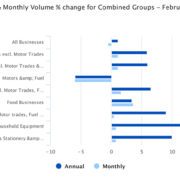
The volume of retail sales decreased by 0.5% in the month of February, with an annual increase of 1.1%.
If Motor Trades are excluded, there was an increase of 1.1% in the volume of retail sales in February 2017 when compared with January 2017 and there was an increase of 5.9% in the annual figure.
The sectors with the largest monthly volume increases were Clothing, Footwear & Textiles (4.9%), Non-Specialised Stores (4.5%) and Hardware, Paints & Glass (4.3%). The sectors with the largest month on month volume decreases were Motor Trades (-5.8%), Fuel (-3.5%) and Pharmaceuticals Medical & Cosmetic Articles (-2.8%).
There was a decrease of 0.3% in the value of retail sales in February 2017 when compared with January 2017 and there was an annual decrease of 0.9% when compared with February 2016. If Motor Trades are excluded, there was an increase of 1.2% in the value of retail sales and an annual increase of 3.3%.
CSO Reports
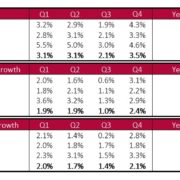
Strong performance in Ireland’s commercial property sector continued throughout 2016, albeit at a slower pace than was seen in 2015, with total returns across all property types up 12.4% annually according to recent figures from the SCSI/IPD Ireland Quarterly Property Index.
The market picked up across all property types in Q4 following a lull in Q3, with industrial leading the way with a total return of 4.6% on quarter bringing annual returns to 19.3% year-on-year. Within this sector the strongest performing category was Industrial North Dublin, which recorded a total annual return of 20.4% driven by capital and rental value growth of 12.6% and 12.2% respectively.
Retail was a close second in Q4, returning 4.3% to bring annual growth to 12.9% relative to 2015. This growth was driven predominantly by prime high street properties on Grafton and Henry/Mary Street, which saw annual returns on investment of 17% and 16.5% respectively. Most importantly, provincial retail is finally beginning to show signs of recovery with capital and rental value growth of 6% and 5.6% driving a total annual return of 14.5%.
Office returned 3.3% in Q4 with prime City Centre properties driving growth to bring total returns to 11.9% annually. This was driven by continued strong growth in prime city centre locations, with Dublin 2 and 4 recording returns of 11% and 12% respectively.
An annual return of 12.4% is almost double the 7.6% recorded in the U.S. and more than three times the 3.5% growth recorded in the U.K., where June’s ‘Brexit’ referendum heavily impacted rental and capital value growth in the latter half of the year. This marks Ireland as one of the best performing commercial property markets again in 2016.
The main quarterly and annual results for 2016 are outlined above.
Kate Ryan, Research Department

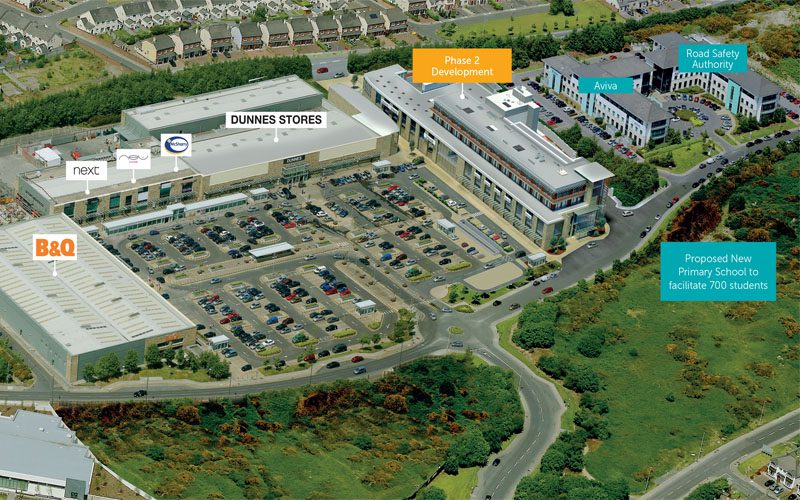
The new owners of the Gateway Shopping Park at Knocknacarra on the western suburbs of the city are to spend more than €20 million on a second phase of the park which will include an additional 11,148 sq. m (120,000 sq.ft) of retail space to accommodate between eight and 12 new traders. The extension, due to be completed in 2018, will bring the overall retail space to more than 29,729 sq.m (320,000 sq.ft). The planned extension will also include Grade A office accommodation extending to 3,344 sq m (36,000 sq.ft).
The Gateway was sold by Nama last year as part of the Hazel Portfolio which also included the high value asset Wilton Shopping centre in Cork and Drogheda Retail Park. A joint venture involving Clarendon Properties and US hedge fund York Capital Management bought the €120 million portfolio and subsequently sold on the two retail parks for more than €50 million to Targeted Investment Opportunities (TIO), a low profile group which invests in the Irish property market through specialist sub-funds.
TIO has now acquired assets with a gross development value of more than €1 billion including seven retail parks with more than one million sq ft of buildings and 50 acres of development land. It is also committed to developing several office buildings in Dublin and various residential schemes including a flagship Public Private Partnership at Greystones Marina Village.
The Gateway park is already producing a rental income of €1.4 million per annum and is managed by Sigma Retail Partners, a specialist company set up by retail adviser Marcus Wren. TIO is chaired by Justin Bickle, the managing director of Oaktree Capital Management, which also serves as investment manager, along with four other experienced directors, John Mulcahy, the former JLL chief executive and Nama executive, Barry O’Leary, the former chief executive of IDA Ireland; Jim Bennett of the Mullingar-based Bennett Construction and the financial services adviser Anthony Noonan.
The Galway park was developed around 2006 by property veteran Michael Whelan. It has considerable advantages over most out-of-town shopping centres because, like Childers Road Retail Park in Limerick and The Park in Carrickmines, it has planning approval for open use retailing. This has allowed it to accommodate a large Dunnes store outlet as well as B&Q, Next, New Look and McSharrys Pharmacy. Apart from this valuable planning consent, the grounds of the Gateway centre includes a 3.94 acre adjoining site which is now to be developed and a further 5.45 acres alongside the entrance which is also commercially zoned. More than 100 workers are expected to be employed on the construction phase with an additional 400 jobs likely to be created when the new shopping facilities have been completed.
Darren Peavoy of Bannon estate agents, who is marketing the planned new buildings on behalf of Sigma Retail Partners, said they had already received a large number of inquiries from both national and international retailers, many of them with long-standing requirements for trading opportunities in Galway. He said it was quite evident that Galway had been under served by international retail brands by comparison to other cities.
The volume of retail sales (i.e. excluding price effects) increased by 0.9% in November compared to the previous month, CSO figures have revealed.
If Motor Trades are excluded, there was an increase of 3.1% in the volume of retail sales in November 2016 when compared with October 2016 and there was an increase of 4.9% in the annual figure.
The sectors with the largest monthly increases were Electrical goods (17%) and Pharmaceuticals Medical & Cosmetic Articles (7.9%). The sectors with the largest month on month volume decreases were Motor Trades (-1.0%) and Bars (-0.9%).
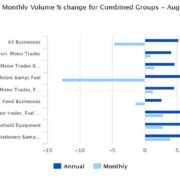
The volume of retail sales (i.e. excluding price effects) decreased by 4.7% in August 2016 when compared with July 2016 and there was an increase of 5.2% in the annual figure.
If Motor Trades are excluded, there was an increase of 0.9% in the volume of retail sales in August 2016 when compared with July 2016 and there was an increase of 4.1% in the annual figure.
The sectors with the largest month on month volume decreases were Motor Trades (-11.1%), Bars, (-2.7%) and Department Stores (-1.1%). The sectors with the largest monthly increases were Furniture and Lighting (+8.8%), Other Retail Sales (+5.1%) and Hardware, Paints & Glass (+4.6%).
There was a decrease of 3.7% in the value of retail sales in August 2016 when compared with July 2016 and there was an annual increase of 2.9% when compared with August 2015. If Motor Trades are excluded, there was no change in the value of retail sales and an annual increase of 1.8%.
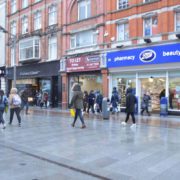
In advance of the rebranding, the organisation undertook a survey of shoppers from the Greater Dublin Area -including counties Kildare, Wicklow and Meath – and found that 59% of them visited the area at least once a month and 28% at least once a week.
Those numbers were below those of the south city area, with 33% visiting each week and 64% of shoppers each month. Nevertheless, Dublin One is well ahead when compared to the numbers visiting Dundrum, Blanchardstown and Liffey Valley.
“Retail is seen as stronger on the northside, but hospitality is stronger on the southside,” says Richard Guiney, managing director of Dublin Town.
This is reflected by 66% of shoppers who say that they like the shops and variety of shops on the north side. Only 54% like the southside shops, despite Grafton Street having the city’s prime retail properties.
Darragh Cronin of Savills agrees that Henry St is more popular with real shoppers. “While Grafton St may have a higher footfall, people go to Henry Street to shop and spending per capita of visitors is higher in Henry Street. Demand is strong for retail units on the street and on that part of Mary Street as far as the junction with Jervis Street,” he says.
Rents can vary, but some stores are achieving rents which are nearly double the average trough seen during the crash.
Last February, the Ann Summers chain moved into 3 Henry St, a shop which is owned by Irish Life, in a move which is expected to double turnover at the ‘pleasure emporium’. It was reported to be paying about €375,000 in annual rent, which works out at about €450 per sq.ft for Zone A, the most shopped in section of a store.
During August, The Health Store and GNC supplements chain took a 10-year lease on Irish life’s 21 Henry St, which has a ground-floor retail area of 979 sq.ft and a total of 3,562 sq.ft over four floors, at a total rent of €210,000 in a letting negotiated by Bannon.
In November 2015, the Dealz chain took a store at 39 Mary Street for around €358 per sq.ft and currently Holland and Barrett are looking to upsize on Henry Street.
Cronin estimates that rents have increased by about 30% on the street in the last 12 to 18 months. However top rents are not available for every store.
“Most of the chains are seeking stores of about 1,500 sq.ft and those types of stores can command the higher rents whereas smaller stores will not generate the same interest or rents,” he adds.
Part of the reason for Henry Street’s stronger retail activity is that more of the street’s shops are designed and built to suit the demands of international retail chains.
“More of them have larger floor plates and shop fronts as well as more glazing compared to Grafton,” Cronin adds.
Another factor is access. Traffic and parking is seen as more of an issue on south side of the city, whereas shoppers appear to consider the northside shops to be as accessible as the key M50 shopping centres.
The south city is ahead when it comes to restaurants, cafes and bars, with 38% preferring those on the southside, compared to 26% liking those on the northside.
“This indicates a need for more quality restaurants and hospitality outlets on the northside, especially in places such as Liffey Street and Middle Abbey Street,” according to Guiney.
Developer solicitor Noel Smyth has signalled the possibility of a hotel on Middle Abbey Street, and the architectural frontage of the former Independent Newspapers building would lend itself to a stylish hotel front. He is also reported to be planning to separate and revamp a part of the existing Arnotts store which would see Arnotts consolidate within its original footprint. He says it’s too soon to comment on plans.
However, he’s not the only one with major projects in the pipeline which will enhance Dublin One’s pulling power.
As well as Deidre Foley’s well-flagged hotel, office and retail development for Clerys former department store on O’Connell Street, Tetrarch Hospitality plans a hotel at the back of Clerys on Sackville Place looking out on a new Luas stop.
In addition Hammerson and developer Joe O’Reilly have had their planning permission extended for their major retail and restaurant development at the Dublin Central site connecting O’Connell Street to both Moore Street and the ILAC Centre, where Hammerson and Allianz have a 50% stake.
The east side of O’Connell Street also looks set for a boost following Mike Ashley of Sports Direct purchasing the former Boyers Store on North Earl Street. This may well strengthen the reputation of this street for value for money shops and attract more apparel stores to the street. In addition Marlborough Street is also likely to benefit from shoppers who catch a tram at Sackville Place.
The Dublin One area is also set for a demographic transformation with the provision of more than 3,300 student accommodation units in the pipeline for 10 projects within its immediate vicinity.
Report in the Independent
Despite retail sales statistics showing a sluggish performance, estate agents report increased activity by retailers and this is reflected in falling vacancy levels in shopping streets and centres.
Agents differ about the impact of Brexit. Marie Hunt of CBRE acknowledges a noticeable increase in cross-border shopping in some border towns in July and August following the weakening of Sterling but says that Irish consumers don’t appear to have curtailed spending in the aftermath of Brexit.
However, another agent says that some UK fashion retailers have pulled back from their Irish expansion plans or put them on hold following Brexit. They are expected to monitor future indices from the Central Statistics Office to see how retail sales trends develop.
In July retail sales in the Republic fell 0.5% when compared with June this year after car sales are excluded. The worst affected shops were clothing, footwear and textiles down 2.5%. Other retail sales were down 2.4% and food, beverages and tobacco were down 0.9%.
Neil Bannon of Bannon points to the other retail sectors that showed continued growth in July, notably furniture and lighting up 5.3% and books, newspapers and stationery up 2%. Furthermore, while the fashion sector fell in both July and June, over the three months including May, fashion sales are 8.7% ahead of the corresponding three months of 2015. All businesses excluding motor are 4.6% ahead.
“We don’t need spectacular growth because there’s always a fear that such growth cannot be sustained. It’s better to have a solid, steady performance,” says Neil Bannon.
Bannon’s agency manages 40 shopping centres in Dublin and around the country and are letting agents on about a quarter of the market. He says there has been a consistent improvement in the retail sector since September 2013.
“It’s not just Dublin; it is also happening around the country on the back of the growth in employment,” he says, and instances Athlone Town Centre where Marks and Spencer are anchors. “This centre has shown retail turnover increase more rapidly than footfall,” Bannon adds.
Other healthy signs have been the drop in examinerships as well as reduced vacancy levels, as the last 12 months have seen the re-emergence of retailer demand for space.
He cites the example of a shop in a north Dublin suburb that had been vacant for almost 10 years and even after the landlord had dropped his asking rent to €20 per sq.ft there were still no takers. Then this year three retailers expressed an interest and made offers, with the highest being 20% more than the rent they would have paid for it last year.
Lisney’s most recent retail report suggests that with increased competition from retailers for vacant space, some landlords have become more choosy about the tenants they are willing to accept for premium retail outlets.
Earlier market indicators suggested that premiums for leases were going to make a comeback this year, particularly on prime shopping streets. However, it would appear that while there are retailers in the market willing to pay premiums in order to acquire prime units, landlords are often not willing to accept them as tenants due to the proposed use (or the quality of their track record).
Lisney’s Emma Coffey says the food sector is driving demand in the city centre, with restaurants and coffee shop operators actively seeking properties in Dublin 2, 4 and 6. However, there was little or no stock available for them to choose from. “In some areas such as Wicklow St, retailers are willing to pay key money. In other areas the demand is not that strong,” says Coffey.
Furthermore, there have been signs that some UK retailers and some restaurant owners are showing resistance to higher rents and requests for key money.
A CBRE survey shows that prime Dublin retail rents have risen almost 39% since the crash. While this places them ahead of all the UK’s regional cities such as Birmingham and Manchester, nevertheless these rents are very much in the middle ranks in European cities.
Neil Bannon says that such higher rent arise because others are competing to get the space.
One area of Dublin that looks set to get a retailing boost in the near future is the eastern side of O’Connell St. Traditionally the western Henry St side, with its large fashion stores, is the favoured side of the street. But with the Luas extension scheduled to travel down Marlborough St and with Mike Ashley’s Sports Direct purchasing Boyers department store on North Earl Street for a reported €12m, the street’s eastern side and nearby retail premises may attract increased interest from a greater range of retailers.
An interesting test of the north city market will be seen when Kennedy Wilson completes the sale of its 3 mobile phone store on Henry St, for which it is asking €8.25m. Its current rent roll is €425,000, suggesting a net initial yield of 4.93%.
Ciara Connolly of Cushman & Wakefield’s retail department says some fashion chains are expanding both within and outside of Dublin. She instances Quiz, which has 10 stores in Northern Ireland and which in the last 12 months has opened in Liffey Valley, Blanchardstown and ILAC in Dublin as well as Douglas in Cork and Crescent in Limerick.
The Bestseller chain, which includes the Jack and Jones, Dila and Selected brands, is also active. Its Selected chain has opened in Dundrum and is looking for stores in Cork and Limerick. The Inditex group, whose Zara brand is long established in Ireland and which last year opened a Massimo Dutti store on Grafton St, is looking to expand its younger fashion brands, especially its Stradavarius and Bershka in new locations. Meanwhile, its Zara Homes is looking at the Grafton St area for a possible new store.
Report in the Independent
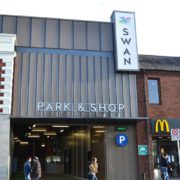
The Swan shopping centre in Rathmines is to get a major boost with the decision by Dublin’s fine food emporium Fallon & Byrne to open a new flagship food hall, delicatessen and casual eatery in the D6 centre.
The new 929 sq.m (10,000 sq.ft) facility will trade alongside anchor tenants Dunnes Stores, Omniplex Rathmines and 15 new traders since the centre was refurbished and upgraded at a cost of €2m.
The owners claim to have re-positioned the Swan centre as “the most dominant shopping and leisure destination in the Dublin 4 and 6 areas”.
Outdoor terrace
Fallon and Byrne’s new outlet will be based in a south-facing contemporary extension complete with an outdoor terrace with ample seating offering the prospect of early-evening sunshine. The stylishly designed extension on Castlewood Avenue will bring a casual dining offering to the area together with a gourmet food hall carrying the best of both Irish and international artisan product brands.
Since the brand’s inception in 2006 Fallon & Byrne has become one of Dublin’s most successful food destinations, delivering a New York-style food emporium, restaurant and wine cellar from its premises in Exchequer Street.
Fiona McHugh, managing director of Fallon & Byrne, said they loved the plans to create an elegant, contemporary extension to the Castlewood Road side of the centre and “very much look forward to creating a beautiful food hall to match”. Paul Anderson, managing director of Sawbridge, owners of the Swan, said the centre was now almost fully let and the addition of Fallon & Byrne as their third anchor tenant firmly placed them as “the primary retail destination within Dublin 6”.
Report in the Irish Times
The volume of retail sales (i.e. excluding price effects) increased by 12.6% in July 2016 when compared with June 2016 and there was an increase of 6.3% in the annual figure. If Motor Trades are excluded, there was a decrease of 0.5% in the volume of retail sales in July 2016 when compared with June 2016 and there was an increase of 2.7% in the annual figure.
The sectors with the largest month on month volume increases were Motor Trades (+12.5%), Furniture & Lighting, (+5.3%) and Books, Newspapers and Stationery (+2.0%). The sectors with the largest monthly decreases were Clothing, Footwear & Textiles (-2.5%), Other Retail Sales (-2.4%) and Food, Beverages & Tobacco (-0.9%).
There was an increase of 4.5% in the value of retail sales in July 2016 when compared with June 2016 and there was an annual increase of 3.9% when compared with July 2015. If Motor Trades are excluded, there was a decrease of 0.5% in the value of retail sales and an annual increase of 0.8%.
Debenhams has emerged as the preferred bidder for its own business in Ireland, seeing off competition from UK billionaire Mike Ashley, who emerged as the only other serious contender for the chain’s Irish arm, the Irish Independent understands.
Mr Ashley, who founded and heads the UK-headquartered Sports Direct chain, has been vying to secure a bigger foothold in Ireland.
Early this year, Sports Direct sealed its €48m acquisition of Irish department store chain Heatons, while it has also acquired the former Boyers store in Dublin for €12m.
Mr Ashley is also a shareholder in the stockmarket-listed Debenhams, owning 10.5% of the group.
Debenhams’ Irish arm was placed in examinership last month under the stewardship of Kieran Wallace of KPMG.
The examinership has laid bare simmering acrimony between the chain and the Roche family, which owns some of the stores from which Debenhams operates in Ireland.
Debenhams acquired Roches Stores in 2006 for €29m, rebranding the outlets.
Debenhams Retail (Ireland) has blamed high rents and staff costs for continuing losses here. The Irish arm is hoping that the examinership process will allow it to secure rent and other cost reductions that will make its business here viable.
Debenhams Retail (Ireland) had sales of €166m last year, but has lost €22.6m over the last three years. Its total annual rent roll is €25m, while staff costs amount to €36.6m a year.
The Irish business has now sought to repudiate at least three leases. It has claimed that it’s paying rents substantially above market rates on some of its premises.
Debenhams says it has paid the Roche family over €100m in rent since 2006 – €94m on just two leases, in Dublin and Cork.
Report by the Independent
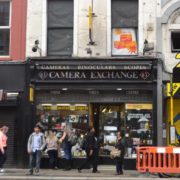
With the demand for retail investments in Dublin city centre still running strongly, agents Bannon has secured €775,000 for the Camera Exchange shop, opposite Dunnes Stores, at 63, South Great George’s Street, Dublin 2.
The three-storey over-basement mid-terrace Victorian building was sold with vacant possession, following the decision by owner-occupier Billy Brennan, who has been running the business since 1989, to close the shop.
The building has an overall floor area of 235.8 sq.m (2,538 sq.ft) with the ground floor extending to 62 sq.m (699 sq.ft).
Report in the Irish Times
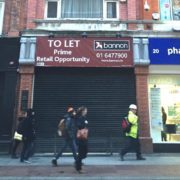
The American health food brand GNC is to open its 16th Irish store at 21 Henry Street, Dublin 1, where it will be paying a rent of €210,000 per annum. The shop was one of four adjoining outlets along with another premises in the GPO Arcade bought by Irish Life two years ago as part of the Capital Collection for over €30m.
GNC’s new shop has a ground-floor retail area of 91 sq.m (979 sq.ft) and a total of 331 sq.m (3,562 sq.ft) over four floors.
With the four adjoining buildings under its control, Irish Life may well opt to amalgamate them at some future date to accommodate international traders looking for a large store. To facilitate such a arrangement, GNC’s new 10-year lease includes a rolling break option for the landlord after year five.
Daniel McLaughlin of Bannon, who handled the lease for Irish Life, said the letting demonstrated the recovery in rents on Henry Street.
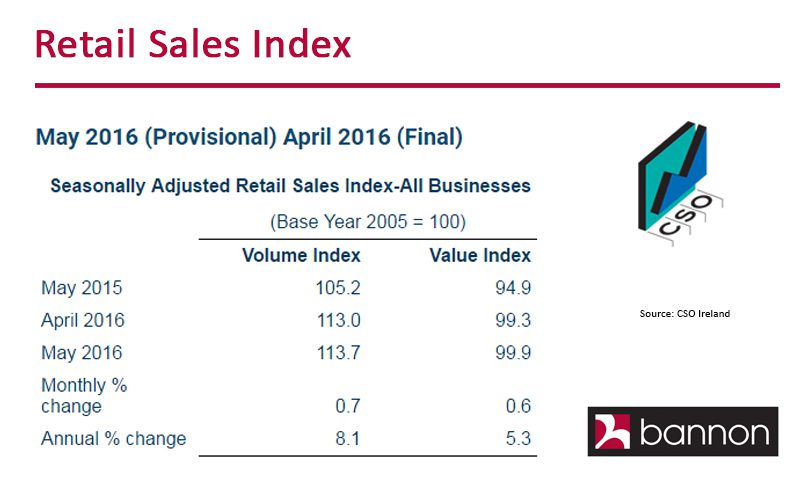
The volume of retail sales (i.e. excluding price effects) increased by 0.7% in May 2016 when compared with April 2016 and there was an increase of 8.1% in the annual figure.
If Motor Trades are excluded, there was an increase of 1.2% in the volume of retail sales in May 2016 when compared with April 2016 and there was an increase of 6.5% in the annual figure.
The sectors with the largest month on month volume increases were Hardware, Paints & Glass (+14.3%), Books, Newspapers and Stationery (+10.1%) and Clothing, Footwear & Textiles (+9.7%). The sectors with the largest monthly decreases were Electrical Goods (-1.9%), Motor Trades (-1.6%) and Food Beverages & Tobacco (-1.2%).
There was an increase of 0.6% in the value of retail sales in May 2016 when compared with April 2016 and there was an annual increase of 5.3% when compared with May 2015. If Motor Trades are excluded, there was an increase of 1.5% in the value of retail sales and an annual increase of 3.9%.

John Lewis, the British department store chain, will dip its toe into the Irish retail market later this year in a partnership deal with Arnotts.
In October Arnotts will open a John Lewis section spanning two floors of its Henry Street, Dublin 1 store, with about 2,000 sq.ft of retail space. It has struck an exclusive deal with John Lewis to sell 700 products from the UK chain’s own-brand home and lifestyle range, including furniture, lighting and kitchenware.
The agreement marks the first major initiative for Arnotts since it was acquired by Galen Weston’s Selfridges group in November. It will also be the first time that John Lewis products have been available in-store in the Irish market.
John Lewis has been eyeing up Ireland for several years, and the deal with Arnotts gives the group a beach-head for any future foray into the local market. It was previously linked with a bid to take over Clerys when that store went into receivership in 2012, although a deal never transpired. John Lewis was also previously thought to be lined up as an anchor tenant for a future extension of the Dundrum Town Centre.
As well as being available in-store, the John Lewis home range will be sold on the Arnotts website. John Lewis began selling to Irish consumers from its own website in 2011.
New brands
Donald McDonald, managing director of Arnotts, said he expects to make further announcements on other new brands for Arnotts over the coming months. Christine Kasoulis, the home buying director of John Lewis, also welcomed the deal with Arnotts.
Selfridges is expected to lay out its longer-term plans for Arnotts later this year. Its controlling shareholder, Mr Weston, is already familiar with the Irish retail market, as the owner of Brown Thomas department store on the southside of the city, and a major shareholder in the group that own Penneys/Primark.
A company linked to Mr Weston previously partnered with property developer Noel Smyth to take control of 50% of Arnotts through the acquisition of bank loans secured on the store.
Last year, the joint-venture with Mr Smyth took full control of Arnotts after it bought out the 50% held by US group Apollo Capital. Selfridges then took over the Arnotts store in November, leaving Mr Smyth with control of adjacent properties and development sites, and the Arnotts car park.
Consumer confidence
Arnotts had sales in the year to the end of January 2015 of more than €114m, although consumer confidence has recovered since then and city centre retailers have reported a strong uplift in sales.
The most recent figures from the Central Statistics Office show that retail sales are growing 5.1%, year-on-year. Some of the strongest growth is in the homewares market.
Report by the Irish Times

The Centra-anchored neighbourhood centre at Sandyford Hall, Dublin 18, is quoting €3.7m through agent Bannon. This price level would reflect an initial yield of 8.1%.
Fully let, Sandyford Hall is producing a rent roll of €321,000 with a weighted average unexpired lease term of 10 years. Many of the tenants at the centre have been in occupation for more than a decade. Centra, whose store has recently been upgraded, occupies a 325 sq.m (3,500 sq.ft) unit with more than 18 years left on its lease.
Other occupiers include Costa Coffee, McCabes Pharmacy and Romayos Diner. There is also a crèche, dry cleaners and dentist.
Located in an affluent and mature south Dublin residential suburb, Sandyford Hall is spread over two levels with six retail units on the ground floor and a further five commercial and offices units on the first floor. According to the agent, 82% of the rent roll comes from the ground floor retail units.
The entire neighbourhood centre extends to 1,423 sq.m (15,313 sq.ft) and benefits from more than 50 surface car-parking spaces.
Article in the Irish Times
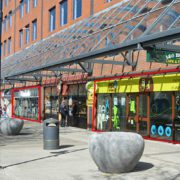
Two external retail outlets rented by Mao and Dominos at The Square town centre in Tallaght, Dublin 24, are to be offered for sale through the Bannon agency for €1,350,000.
The highly rated investment will show an immediate return of 7.22% after standard acquisition costs are deducted.
Alex Patterson of Bannon advises that after a rent review due in 2017 on the Moa outlet the yield on the investment will rise to 9%.
The two units are located next to the level 1 entrance and benefit from very considerable pedestrian traffic between The Square and Tallaght village.
Occupiers
Fast food giant Dominos occupies unit 135 which extends to 81.7 sq.m (879 sq.ft) on a 25-year lease from 1999 at a passing rent of €74,880.
There are eight years remaining on the upwards-only lease.
The outlet is believed to be one of the busiest in the country operated by Dominos.
Unit 137/a, extending to 136sq m (1,464sq ft), is occupied by Mao at Home on a new 15-year lease from 2012 at a low passing rent set in 2012 of €25,000. The agent expects this rent to double when it is reviewed next year.
Both units have shares in the centre management company.
Article in the Irish Times
The first quarter of 2016 saw a continuation of the impressive performance seen in the past two years with most key economic indicators registering steady growth. Most importantly, personal consumption is now seeing sustained growth, up 3.5% year-on-year for 2015 demonstrating a consumer economy that is now firmly in recovery.
The KBC/ESRI consumer sentiment index hit a fifteen year high of 108.6 in January 2016. By March, however, Irish consumer sentiment had weakened significantly with the index falling to a six-month low of 100.6. This drop has been linked to prolonged political uncertainty following February’s inconclusive general election, as well as the imminent Brexit vote in the UK. Nevertheless, the three-month moving average remained strong at 105.0 in March 2016, representing an annual increase of 6.8%.
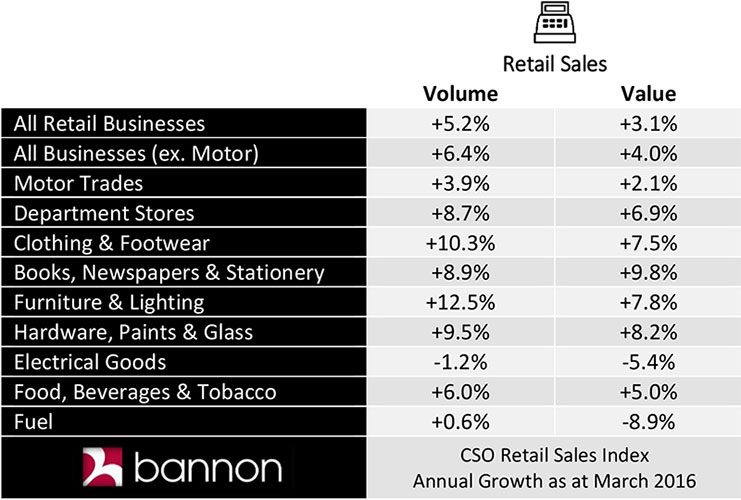
Irish retail sales are seeing steady growth in 2016 with the latest CSO figures showing sales volumes to have increased by 5.2% in the year to March 2016. When motor trades are excluded, sales volumes are up 6.4% annually to reach a level not seen since 2007. Sales volumes do not tell the full story however, and price discounting has meant that the total value of retail sales has seen slightly slower growth, up 3.1% annually during this period, or 4.0% excluding motor trades. The strongest performing sectors in the year to March 2016 (in volume terms) were furniture & lighting (+12.5%); clothing, footwear and textiles (+10.3%) and books, newspapers and stationery (+8.9%).
The Visa Europe Consumer Spending Index shows that there has been no slowdown in household expenditure in the first quarter of 2016, registering a year-on-year increase of 5.6% across all payments in March. This compares with slower growth in the UK, where spending is up 2.3% for the same period. Irish high street retailers are seeing an increased willingness among consumers to spend on discretionary items, leading to a 3.8% annual rise in face-to-face expenditure, while online spending continued to see a sharper expansion, up 9.5% year-on-year.
Annual growth rates in both the value and volume of sales for key retail sectors are outlined above.

The Limerick-based woman who won the Euromillions jackpot has failed in her attempt to buy Limerick’s top performing retail park. Ms Dolores McNamara was outbid for Childers Road Retail Park near Limerick University by Irish Life, the country’s largest commercial property owner with assets of over €2.5 billion.
Ms McNamara was a surprise bidder last week, making an offer above the €44 million guide price set by managers Harcourt Life.
Irish Life and a UK fund Savills Investment Managers also bid above the guide price.
In the second and final round Irish Life led the field with an offer of just under €46 million.
Ms McNamara, who scooped € 115 million in the 2005 Lotto jackpot, had not previously been known to have an interest in the commercial property market.
Had she acquired Childers Road, it would have earned her an annual rent of €3.22 million with the prospects of rent increases every five years from a range of traders including Boots, Next, Life Style Sports, Argos and fashion stores including Burton, Wallis, Evans and Dorothy Perkins.
Childers Road is by far the best performing park in Limerick: two other retail parks in the city are selling for less.
One close by known as Parkway is for sale at over €27.5 million and has a rent roll of €2.02 million.
On the opposite side of the city, a buyer is being sought for Ennis Road Retail Park which produces a rent of €1,476,000 and is on the market at €15 million.
Martin O’Reilly, head of property fund management at Irish Life Investment Managers, said their acquisition of Childers Road added a unique retail asset to their portfolio given the open use nature of the park and the general absence of this arrangement in the Irish market.
The acquisition came at a time when it is seeing consistent growth in consumer spending and continually improving economic indicators across the retail sector.
The tenant lineup of strong international brands illustrated the park’s regional dominance.
Rod Nowlan of the Bannon advised Irish Life.
Report by the Irish Times
A dramatically improved labour market and strong economic performance are having a knock-on effect on the consumer economy. This is reflected in the KBC/ESRI consumer sentiment index which shows confidence levels to have increased by 10.6% in the year to February 2016 to reach a 15-year high. This has been reflected in retail spending, boosted by increased disposable income through employment growth and reductions in tax burdens.
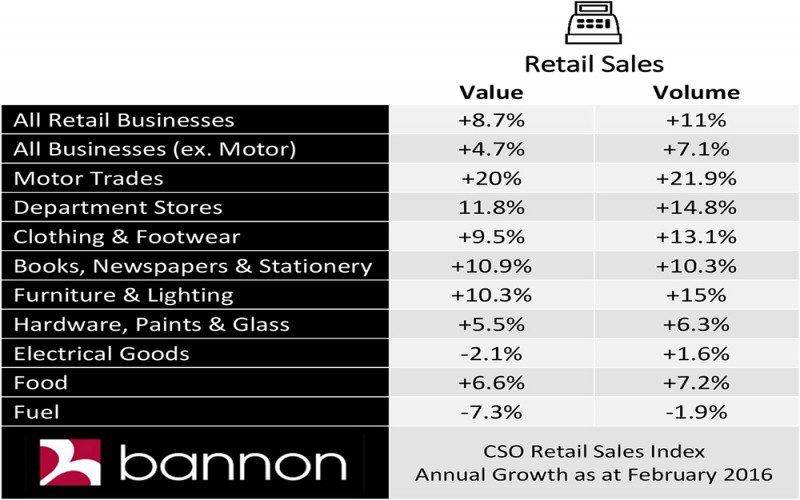
Irish retail sales remain strong in 2016 with the latest CSO figures showing annual growth to have surged by 11% in February, while the value of retail sales increased by 8.7% year-on-year. If motor trades are excluded, the volume of retail sales are up 7.1% year-on-year while values grew by 4.7%.
The breadth of the remarkable recovery in the retail sector is evidenced in the fact that all retail categories, with the exception of fuel, saw annual increases in volume terms while 11 out of 13 retail categories saw increases in sales values. The strongest performing categories were cars (+21.9%), furniture and lighting (+15%) and department stores (+14.8%).
Annual growth rates in both the value and volume of sales for key retail sectors are outlined above.
Prime office and retail rents in Dublin are expected to rise by about 12% in 2016, while residential development land values in the capital are expected to rise by a similar amount according to a new commercial property survey by the Society of Chartered Surveyors Ireland.
Surveyors expect prime office rents in the rest of the country to increase by between 5% to 6% while retail rents are expected to increase by 7% to 8% in Munster and Leinster (excluding Dublin) but by 4.5% in Connacht.
The survey found that investment in the commercial property market reached approximately €3.7 billion in 2015. While this figure is below the record investment level of €4.5 billion achieved in 2014, it nevertheless represents an exceptionally buoyant year for Irish property investment, as all sectors of the market recorded marked increases in activity.
The 2015 property market has seen investment spread more broadly through the regions compared to 2014, when investment was largely focused on the Dublin Region.
Close to 500 Chartered Surveyors were surveyed for the SCSI annual report which was developed and published in conjunction with Future Analytics Consulting.
Office Sector
According to the report there was a 24.1% year on year increase in prime office rents in Dublin in 2015 which reflects the continued demand for city centre locations from new and existing investors, particularly from technology based companies. Positively, respondents also noted an increase in investment activity and a rise in the number of firms that located in suburban areas in 2015, enticed by lower rental prices and newly renovated facilities.
The Review found that prime office rents in the capital were priced at €561 per sq.m at the end of 2015 but are set to increase by a further 11.7% this year.
Regional locations also experienced an increase in office sector demand. Respondents reported a marked increase in activity and demand for office space in the regional cities as the economic recovery resulted in an increase in new company formations and expansions.
This trend is likely to continue in 2016 as respondents predict that prime office rents in Connacht/Ulster will increase by 5.2% and in Munster and Leinster (excluding Dublin) by 5.9% and 6.1% respectively.
Brian Meldon, SCSI Commercial Agency Professional Group Chair, said; “While some respondents are anticipating an increase in supply in 2017, no new office space has been delivered to the Dublin market for the last five years and as a result demand continues to surpass supply. As a result, there are ongoing concerns about Dublin’s ability to continue to attract service sector Foreign Direct Investment in the absence of appropriate office space.”
“Concerns have also been raised by respondents about the lack of housing for potential future employees, as well as access to high quality public transport which could act as barriers to investment in the office sector in the short term. These concerns should weigh heavily on the minds of Ireland’s political parties who will contest the upcoming general election on the back of their plans for further job creation” he said.
Retail
In the retail sector, retail rents in Dublin’s Grafton Street grew by approximately 17.9% in 2015. Rents increased by 16.8% for prime rental in Dublin as Zone A prices reached €5,247 per sq.m. Respondents to the survey expect prime retail rents in Dublin to increase by 11.5% in 2016. In Connacht/Ulster, they are expected to increase by around 4.5% and in Munster and Leinster by approximately 8.0% and 7.2% respectively.
Brian Meldon said rental value growth within the retail sector had increased progressively throughout the course of 2015.“This reflects a strengthening domestic economic recovery and improving consumer sentiment. However, demand in town centres, suburban areas and neighbourhood shopping centres remains subdued and higher vacancy rates will likely remain a challenge within these areas in 2016, despite the positive forecasts for rental value growth”
Development Land
Development land values continued to increase in 2015. Most notably, residential development land increased by 19.7% in Dublin, 16.7% in Munster, 15.1% in Leinster and 10.0% in Connacht/Ulster. SCSI members anticipate residential development land values in Dublin will increase by around 12.1% in 2016.
However, growth in the value of office development land in Dublin surpassed all other development land types in all regions, with a rise of 26.7% in 2015. This growth is set to continue in to 2016 with expected increases of 16%. Notably, Dublin is the only region in which growth in the value of office development land exceeds growth in the value of residential land.
Brian Meldon said the increasing demand for housing and office units has strongly contributed to a growth in development land activity.
“Development finance remains the biggest single issue in ensuring additional new residential and commercial units are built over the short-term. Many contractors are reportedly experiencing very limited access to finance, with lending of only 30% to 50% being offered by financial institutions; with high interest rates and other inputs adding further to development costs. Ensuring the availability of development finance for measured speculative development, as well as speeding up the planning system will address supply issues and create a more sustainable market.”
Industrial
The industrial sector also experienced positive growth, and while much of this was focused on the Dublin market, the Munster Region experienced the greatest levels of rental growth, albeit from a low base. In Dublin, prime industrial rents under 500 sq.m increased to €84 per sq.m, representing an increase of approximately 2% year-on-year, while secondary rents on properties over 500 sq.m increased by 34.1% to €55 per sq.m.
“Industrial rental values continued to strengthen in 2016. Demand was strong for logistic-type properties, as the logistics networks expanded to meet the growing online retail phenomenon. There is an undersupply of these large-scale, modern logistic-style units, and build costs for such units remains high, undermining the financial viability of any speculative development” Meldon concluded.
Survey by SCSI
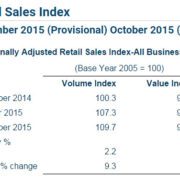
Heading into the Christmas trading period, the Irish sector saw a big rise in the volume of retail sales in November.
Data from the Central Statistics Office showed that sales were 9.3% higher on the same month a year earlier, and up 2.2% on the previous month.
Buoyed by Black Friday activity, sales of electrical goods were up 13.6%, while department stores volumes increased by 7.4%. Food retailers experienced the lowest growth at just over 5%.
There was an increase of 1.6% in the value of retail sales in November 2015 when compared with October 2015 and there was an annual increase of 5.6% when compared with November 2014. If Motor Trades are excluded, there was an increase of 2.0% in the value of retail sales and an annual increase of 4.9%.


Agents Bannon are delighted to present to the market the sale of Hazel Portfolio, comprising of two provincial shopping centres and one retail park. Geographically diverse collection of retail assets which benefit from their position as dominant retail centres in their respective catchments. High profile tenants include Pennys, TK Maxx, Next, New Look, Homebase, B&Q and Harvey Norman.
1. Wilton Shopping Centre is located in the suburb of Bishopstown approximately 3 kms south west of the city centre and opposite Cork University Hospital.
Wilton Shopping Centre is the second largest shopping centre in Cork (after Mahon Point), with an impressive footfall of approximately 105,000 per week (5.5 million per annum). The centre extends to 10,151 sq.m (109,259 sq.ft) (excluding Tesco) of sales, ancillary and storage accommodation over predominately one trading level. The shopping centre has extensive surface car parking, 607 included within the sale and a further 394 relating to Tesco, situated on a site area of approximately 9 hectares (23 acres).
2. Drogheda Retail Park is situated at Junction 9 of the M1 Motorway and Donore Road. It was developed in 2005 with additional phases added in 2006 and 2008. The entire extends to approximately 19,919 sq.m (214,405 sq.ft) across 15 units with over 982 free surface car parking spaces.
Included in the sale is Unit 15 Newgrange Business Park which is located adjacent to the Retail Park. The unit is fully occupied by Blackstone Motors at a passing rent of €120,000 per annum with a term certain of 5.87 years. This unit is located close the Tesco F60 store.
3. Gateway Retail Park is located on the west side of Galway City just off the Bothar na dTreabh via the Western Distributor Road. The surrounding area is a densely populated suburb of Galway City with undeveloped residential zoned land which has potential to absorb future housing demand.
The Retail Park forms part of a wider estate which includes an office development occupied by Aviva and an industrial unit occupied by Zenimax. Planning permission was granted for Aldi immediately adjacent to Gateway Retail Park with site works underway. Planning permission was also granted for a primary school on adjacent lands.
The retail park was developed in 2005 and comprises over 7,798 sq.m (83,936 sq.ft) across four units (excluding Dunnes). Car parking is provided at surface and basement levels for 698 cars.
Should you require further information or would like to discuss the opportunity in more detail please feel free to contact Alexandra Patterson on +353 1 6477900.
NAMA has launched the sale of a provincial shopping centre and two retail parks, formerly owned by separate investors and developers, dubbed the Hazel portfolio, and is seeking offers in excess of €115m.
The Hazel portfolio is split in terms of value between the dominant suburban shopping centre in Cork and two provincial retail parks.
A sale at €115m would reflect a net initial yield of approximately 7.47%, based on a net operating income of €8.97m. The weighted average unexpired lease term is 9.11 years and the portfolio vacancy rate is just 2.1%.
The Hazel retail portfolio, which will be sold jointly by Bannon and DTZ, comprises:
First round bids are expected to be called around the third week of October.
Rod Nowlan, director of investment at Bannon and Karl Stewart, director at DTZ Sherry FitzGerald, who are handling the sale, said: “The Hazel Portfolio provides investors with an opportunity to access a cross section of the retail market with high quality schemes which are imbedded in their respective catchments.
“All assets enjoy a low level of vacancy and strong tenant line up and unlike many recent more provincially focused portfolios the assets are not overburdened with excessively over-rented units’. Their fundamentals are secured off the back of strong cities or a thriving Dublin commuter town.”
Reported by costarfinance.com
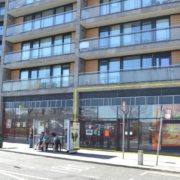
A somewhat unique investment opportunity is being launched to the market by Bannon. The unit at Belgard Square West in Tallaght comprises a former supermarket unit which is situated directly opposite The Square Town Centre. It formerly traded under the SuperValu brand and extends to 1,439 sq.m (15,486 sq.ft). Neighbouring occupiers include Boyle Sports, Polonez, Smiles Dental Spa and Aussie Outback.
Although currently vacant there is a Put and Call Option in place which enables the owner to call on Musgrave Ltd to purchase the unit at a pre-determined purchase price of just under €9 million. This Call Option is exercisable from 31 December 2019.
Niall Brereton of Bannon is handling the sale and comments that; “given the low levels of returns that are available on deposit this presents investors with an opportunity to acquire an agreed level of future income from one of Ireland’s largest companies at a significant discount. In the meantime the potential exists to increase returns through a letting of the unit”.
The quoting price of €6 million represents just two thirds of the Call Option price which is obtainable in just over 4.5 years’ time.
Retail Sales Volume increased by 1.4% in March 2015, an increase of 9.2% in the annual figure. Sectors with the largest month on month volume increases were Motor Trades (+4.1%), Bars (+4.0%) and Other Retail Sales (+2.6%)
If Motor Trades are excluded, there was a decrease of 1.0% in the volume of retail sales in March 2015 when compared with February 2015 and there was an increase of 4.7% in the annual figure.
The sectors with the largest month on month volume increases were Motor Trades (+4.1%), Bars (+4.0%) and Other Retail Sales (+2.6%). The sectors with the largest monthly decreases were Department Stores (-3.2%), Non-Specialised Stores (excluding Department Stores) (-2.4%) and Fuel (-1.0%)
There was an increase of 1.2% in the value of retail sales in March 2015 when compared with February 2015 and there was an annual increase of 5.7% when compared with March 2014. If Motor Trades are excluded, there was a monthly decrease of 0.9% in the value of retail sales and an annual increase of 1.2%.
Central Statistics Office reports
Retail Ireland, the Ibec group that represents the retail sector, today published its Q1 Retail Monitor, with key indicators pointing to further improvements in the sector’s performance this year. This follows positive trends during 2014 and a Christmas trading period up on 2013. Strong January VAT returns, which were €225 million or 12.9% ahead of last year, suggest the recovery is starting to gain traction.
The sector is still operating at levels far below that reached during the boom years. Turnover is down nearly 20%; employment in the sector has fallen by 44,000; and 3,500 retail units closed during the recession. Many businesses are still constrained by boom time costs and charges.
Ibec estimates consumer spending will rise by 2.7% in 2015, following growth of 1.3% last year. Key factors supporting further recovery over the coming months include an expected rise of 55,000 in the numbers at work, and a rise of 3.5% – 4% in disposable income. The dramatic fall in oil prices will also boost consumer spending power. Every $10 fall in the price of a barrel of oil translates into an additional €100 million spending power for Irish consumers.
Consumers look set to benefit from yet another year of low inflation, with intense competition keeping prices down. The group estimates overall inflation in the economy to be 0.4% this year. At present, goods inflation is at minus 2% annually as shops battle for footfall.
View report
The volume of retail sales (i.e. excluding price effects) increased by 0.5% in December 2014 when compared with November 2014 and there was an increase of 5.1% in the annual figure.
If Motor Trades are excluded, there was an increase of 1.9% in the volume of retail sales in December 2014 when compared with November 2014 and there was an increase of 4.8% in the annual figure.
The sectors with the largest month on month volume increases were Pharmaceuticals Medical & Cosmetic Articles (+4.5%), Hardware, Paints & Glass (+3.9%) and Fuel (+2.3%). The sectors with the largest monthly decreases were Furniture and Lighting (-2.3%), Other Retail Sales (-1.6%) and Clothing, Footwear & Textiles (-1.1%).
There was a increase of 0.1% in the value of retail sales in December 2014 when compared with November 2014 and there was an annual increase of 2.3% when compared with December 2013. If Motor Trades are excluded, there was a monthly increase of 0.9% in the value of retail sales and an annual increase of 1.7%.
The value of retail sales increased by 0.1% when compared to November and were up 2.3% in the annual figure.
The volume of retail sales (i.e. excluding price effects) increased by 0.2% in November 2014 when compared with October 2014 and there was an increase of 4.7% in the annual figure. If Motor Trades are excluded, there was an increase of 0.1% in the volume of retail sales in November 2014 when compared with October 2014 and there was an increase of 3.6% in the annual figure.
The volume of Clothing, Footwear & Textiles increased by 2.2% and Department Stores increased by 1.6%.
The value of retail sales decreased by 0.2% in November 2014 when compared with October 2014 and there was an annual increase of 2.2% when compared with November 2013. If Motor Trades are excluded, there was a monthly decrease of 0.3% in the value of retail sales and an annual increase of 1.2%.

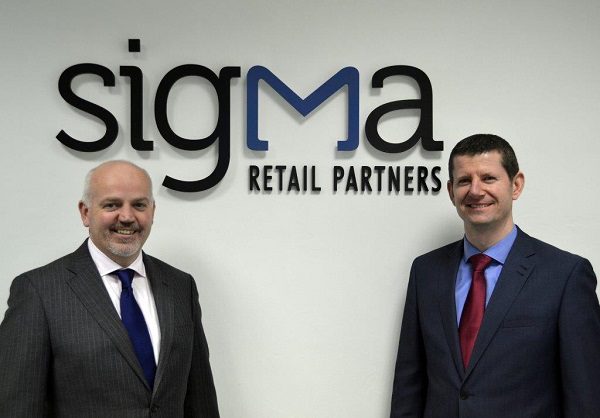
Pictured: Neil Bannon (left) and Marcus Wren (right)
Marcus Wren, former Senior Retail Property Advisor with The National Asset Management Agency (NAMA), has opened Ireland’s only specialist retail asset management company.
Sigma Retail Partners will provide a wide range of retail asset management services and expert advice to banks, private owners and national and international investors.
Mr. Wren left NAMA in early October and throughout his time there he played a key role in managing NAMA’s vast portfolio of retail assets. He worked with hundreds of retailers and owners many of whom were experiencing significant difficulties due to the collapse in the Irish economy.
Marcus Wren has over 20 years experience in the retail property sector. Prior to joining NAMA he was a co-founder and Director of Bannon, one of Ireland’s most successful commercial property firms with particular expertise in the retail property sector.
Neil Bannon of Bannon is also a co-founder and Director of Sigma Retail Partners and brings with him 25 years of retail asset management and property management experience. Mr. Bannon played a key role in the design, letting and asset management of many of Ireland’s prominent retail developments including Dundrum Town Centre, the most successful shopping centre in the country.
Irish shops are bracing themselves for their best Christmas since the nadir of the economic collapse, with a new report suggesting consumers are set to spend €4 billion between now and the new year.
The upbeat forecast is contained in Retail Ireland’s Christmas Monitor, which tracks key trends across the economy and the retail sector to give an insight into how they are likely affect the crucial Christmas trading period.
The monitor shows that €3.96 billion is likely to be spent in shops this December, up from €3.88 billion last year, with Irish households set to spend between €650 and €750 more in shops this month, than other months of the year.
The monitor, from Ibec’s retail division, shows that sales in the first nine months of this year are up 1.5% in value terms on the same period last year and it pointed to rising employment as a key driver of greater spending.
Retail Ireland’s most recent forecasts said there would be about 35,000 more people at work since last Christmas and almost 96,000 more than there were in Christmas 2012.
Disposable income has continued to climb. It increased by 3.3% in 2013 and Retail Ireland said it expected it to grow by a similar percentage this year after significant falls between 2008 and 2012.
Consumer sentiment is at its highest since 2007, with the annualised average of the ESRI/KBC consumer sentiment index 30% higher than in 2013 and 70% higher than in 2008 and 2009.
Retail Ireland said competition remained intense across the retail sector and it anticipated that prices would be kept down. At present, goods inflation is at minus 2% annually as shops battle for footfall.
Sales period
Goods prices this December are on course to be at their lowest level since December 2002, with downward pressure expected to continue into the post-Christmas sales period.
However, he warned that retailers were still paying “unsustainable high rents” and called on the Government to back Senator Feargal Quinn’s Bill on upward-only rent reviews.
View Media Article by Conor Pope

The centre is for sale by private treaty from Joint selling agents Bannon and Bundoran-based Sean Meehan & Co. The property is being sold on the instructions of receiver Tom Kavanagh of Deloitte.
The shopping centre is located right in the town centre and features significant amounts of on-site parking. It includes an anchor store of 734.3 sq.m and twelve retail units over two levels comprising 649 sq.m. There are three well-proportioned office suites on the first floor.
The current rent roll is €37,580 with an immediate opportunity for potential purchasers to increase revenues through active lettings.
There are 12 retail units and an anchor store with a further 3 office suites on the first floor.
At present three of the retail units are occupied with the anchor store also under offer.
The three office suites are occupied two of which are held under a short term tenancy with the HSE.
The agents expect strong interest with the quoted price level at an attractive €650,000, given the centre’s proximity to the seaside resort of Bundoran, the commercial centre of Donegal Town and the adjoining County Fermanagh hinterland.
The anchor store was formally occupied by a Mace supermarket. The supermarket closed in May last year.
Please contact Jennifer Mulholland of Bannon today for further information on 01 6477900
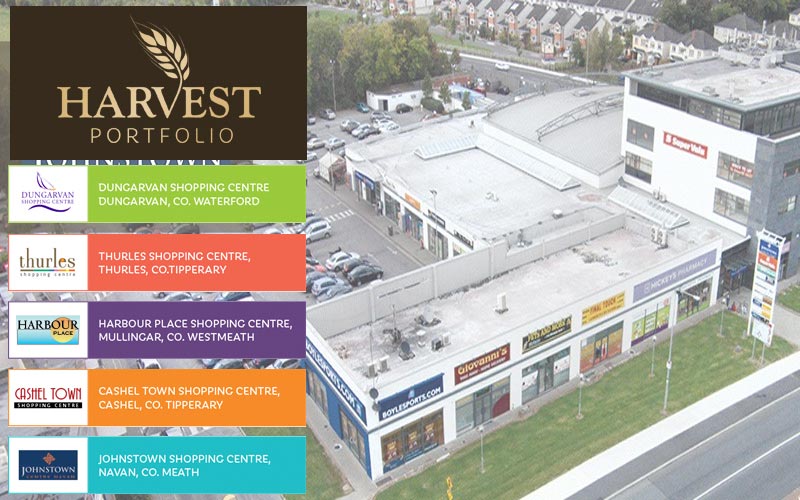
Five relatively small provincial shopping centre are to be offered for sale on the instructions of Nama.
Joint agents Bannon and Lisney are to seek in excess of €50 million for the grocery-led centres in Dungarvan, Thurles, Mullingar, Navan and Cashel which are to be sold in a single lot.
The Harvest Portfolio is producing a combined rent of €4.8 million which will give the purchaser an initial yield of just over 9%. Deloitte, the professional services group, is co-coordinating the sale of the various centres which are anchored by leading multiples Dunnes Stores, Supervalu and Tesco. In only one case – Cashel – the anchor store rented by Tesco is included in the sale. There are more than 100 traders in all in the various centres which have an overall floor area of 24,154 sq.m (260,000 sq.ft) and a vacancy rate of 2,787 sq.m (30,000 sq.ft).
The portfolio also includes more than five acres of development land, much of which is expected to be used if the pick up in the retail market continues. Whoever buys the centres will inevitably press to have the vacant commercial space let.
The overall rent is about €1.5 million and the weighted average unexpired leases work out at 11 years. One of the attractions here is that the sale includes 4.5 acres which are zoned for “town centre” use. Dunnes Stores Thurles Shopping Centre has an overall retail area of 4,645 sq.m (50,000 sq.ft) apart altogether from the main supermarket which is owned by Dunnes Stores.
The centre is producing a rental income of €1.15 million and with an average of 6.9 years still unexpired on the various leases the centre could well be valued at about €12 million. Dunnes are also the principal player in Harbour Place Shopping Centre in Mullingar which is trading well and is valued at about €10 million. The line of tenants includes Boots, Holland & Barrett and Peter Mark and the rental income comes to €970,000. Typical leases have another 5.44 years to run. Cashel Town Shopping Centre is the only purpose built retail complex in town and with Tesco contributing most of the rental income of €730,000 on a long term lease the overall value of the complex is likely to be at least €8 million. The average unexpired lease term is 12 years.
Tesco also operate a petrol filling station between the centre and junction 9 of the M8 motorway. Whoever buys the portfolio will undoubtedly launch a renewed marketing campaign to find tenants for about 20 shops lying vacant in what is an impressive looking centre.
The fifth retail complex in the portfolio, Johnstown, is located more than two miles from Navan on the edge of a string of housing estates owned mainly by Dublin workers attracted by cheaper house prices during the boom. Best-run supermarket The centre has what many shoppers acknowledge is the best-run supermarket in town – Supervalu.
The remaining tenants, including Hickeys pharmacy and Boyle Sports, contribute to the overall rental income of €425,000. The average lease term remaining here is 13.5 years and a new owner could increase the rental return if a tenant can be found for around 929 sq.m (10,000 sq.ft) of office space over the complex. The Johnstown centre is thought to have a valuation of about €4 million.
Rod Nowlan of Bannon and Duncan Lyster of Lisney said the sale provided investors with an opportunity to access “the improving Irish economy through a resilient collection of grocery-led retail schemes which are embedded in strong regional towns.”
The various assets provided strong cash flows from tenants that were largely paying rebased rents. Each of the schemes offered significant asset enhancement opportunities to improve their position in their respective markets and enhance returns.
For more details please contact Rod Nowlan of Bannon today on 01 6477900 or for more information visit www.harvestportfolio.com
Regatta, the high performance outdoor wear brand, is opening a flagship store at the Pavilions Shopping Centre today, with another store to follow in Athlone Town Centre soon. Congrats to the Bannon letting team.
Regatta is the UK’s largest supplier of outdoor and leisure clothing and a leading player in the European market. The chain currently operates a €10 million-a-year wholesaling business and 10 concession outlets based in Shaws department stores, together with a standalone retail outlet in the Crescent shopping centre in Limerick.
IPUT plc has completed the acquisition via sale and leaseback of a high specification logistics facility at Blanchardstown Corporate Park for approximately € 10.5 million in an off market transaction that will see Musgrave’s remain in occupation of the building under a long term lease and provide IPUT with an income yield of 7.75%.
The property which was purpose built for Superquinn in 2001 is regarded as an international class logistics facility comprising distribution and offices extending to 185,946 sq.ft. The facility includes ambient warehousing of approximately 136,432 sq.ft, chill room of approximately 39,826 sq.ft and office accommodation of approximately 9,688 sq.ft on a site of 4.45 hectares (11 acres). Planning permission was granted in 2004 for a 70,207 sq.ft warehouse extension which offers potential for further development on the site in the future.
Musgrave Group is Ireland’s leading retail and food service wholesaler with an annual turnover in excess of €4.5 billion.
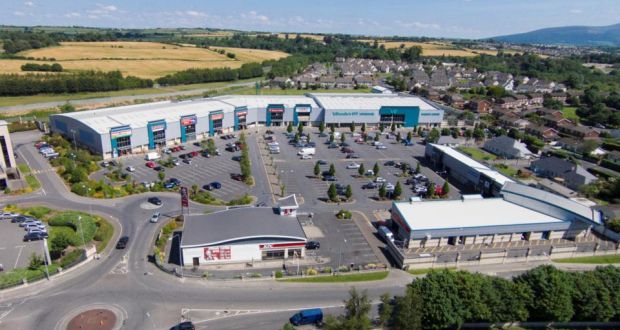
IPUT property fund is to take over ownership of Carrickmines Retail Park in south Dublin as part of a successful tender by the New York-based Marathon Asset Management for the Irish retail parks portfolio. IPUT offered around €78 million for just the Carrickmines retail Park in the first round of bidding but Nama thought it should not be sold on its own but rather as part of the Parks Portfolio which also included four lesser-known parks in Drogheda, Mullingar, Clonmel and Carlow.
IPUT then joined forces with New York-based Marathon Asset Management who had survived the first round after pitching for the entire portfolio – a final bid of approximately €157 million for all five parks – €47 million above the guide price.
Carrickmines Retail Park is currently producing a rental income of €4.4 million which will rise by another €300,000-plus if, as expected, a leading furniture retailer rents a vacant building on site extending to 974 sq.m (10,500 sq.ft). Woodies DIY and garden centre is the anchor tenant paying a rent of €1.8 million for 6,038 sq.m (65,000 sq.ft).
The volume of retail sales increased for the 11th month in a row this year, September edging 0.1% higher compared with August, and there was an increase of 5.9% for the year, according to the CSO report. If Motor Trades are excluded, there was a decrease of 0.6% in the volume of retail sales in September 2014 when compared with August 2014 and there was an increase of 3.1% in the annual figure.
There was a decrease of 0.2% in the value of retail sales in September 2014 when compared with August 2014 and there was an annual increase of 3.8% when compared with September 2013. If Motor Trades are excluded, there was a monthly decrease of 1.1% in the value of retail sales and an annual increase of 1.0%.
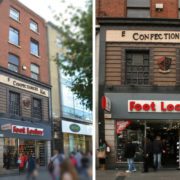
Bannon are guiding €4 million for 49 Lower O’Connell Street, a Georgian retail building rented by Footlocker at €240,000 a year. The investment will show an initial return of just under 6%.
The five-storey over basement building is located at the southern end of the street close to Penneys, McDonald’s and Schuh. It has an overall floor area of 483 sq.m (5,205 sq.ft) and previously had retail use on the first floor as well as at street level.
Footlocker concentrates all its selling efforts on the ground floor and uses the additional space for offices and storage.
There are 13 years remaining on the lease with the next upwards only review due in 2017.
David Carroll of Bannon, who is handling the sale, said the building had a “great profile” beside what would be a very busy intersection of the Luas cross-city service and the Luas red line. The €4 million sale would appeal particularly to cash buyers and debt-backed investors.
The BWG group, the owners of SPAR, are to invest €100m in store development over the next five years. The investment will see 50 new stores open around the country between now and 2016 with the creation of approximately 1,000 jobs.
The announcement was made at a SPAR retailer convention in Killarney this morning. It follows the recent investment by BWG South Africa, which saw it take an 80% holding in the group.
The European Union’s statistics office Eurostat has reported that retail sales in the euro zone rose 1.2% month-on-month in August with 1.9% year-on-year gain.
The 1.2% increase in the volume of retail trade in the euro area in August 2014, compared with July 2014, is due to rises of 1.7% for automotive fuel, of 1.5% for the non-food sector and of 0.6% for “Food, drinks and tobacco”.
Monthly Comparison
The highest increases in total retail trade were registered in Germany and Luxembourg (both +2.5%), Portugal and Sweden (both +2.3%) and Poland (+2.2%), and the largest decreases in Romania and Slovakia (both -0.6%).
Annual Comparison
The 1.9% increase in the volume of retail trade in the euro area in August 2014, compared with August 2013, is due to a rise of 3.6% for the non-food sector, while both “Food, drinks and tobacco” and automotive fuel fell by 0.2%. Total retail trade rose in all Member States for which data are available, with the highest increases observed in Luxembourg (+12.5%), Estonia (+6.7%) and the United Kingdom (+5.6%).
The Central Statistics Office report released yesterday shows the volume of retail sales (i.e. excluding price effects) decreased by 2.9% in August 2014 when compared with July 2014 and there was an increase of 6.8% in the annual figure. If Motor Trades are excluded, there was an increase of 0.3% in the volume of retail sales in August 2014 when compared with July 2014.
There was a decrease of 1.3% in the value of retail sales in August 2014 when compared with July 2014 and there was an annual increase of 5.3% when compared with August 2013. If Motor Trades are excluded, there was a monthly increase of 0.1% in the value of retail sales and an annual increase of 2.2%.
The sectors with the largest month on month volume increases were Furniture and Lighting (+11.0%), Bars (+2.6%) and Electrical Goods (+2.2%). The sectors with the largest monthly decreases were Motor Trades (-4.4%), Hardware, Paints & Glass (-2.6%) and Food, Beverages & Tobacco (-2.4%).
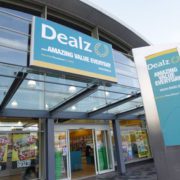
UK-listed discount retailer Poundland is planning to open six new Dealz stores in Ireland over the next year. The new openings will bring to 41 the number of shops in the Republic for Dealz, which opened here three years ago.
To date, the UK company has invested approximately €53 million in its Irish network with about €4.5 million being spent this year on its expansion. It attracts about 200,000 customers a week to its Irish stores. The group’s revenues from the Republic amounted to £55 million for the year to the end of March 2014.
An Bord Pleanála has given the go ahead to a €40 million extension of The Square shopping centre,Tallaght. A development that is being supported by the National Asset Management Agency. Permission was granted to Indego, which owns about 70% of the units at The Square, following an appeal by Dunnes Stores in April.
The project will create about 300 jobs during construction, which is due to begin in spring 2017. It will add about 200,000 sq.ft of retail space, creating 400 jobs. A multi-storey car park over six levels with approximately 800 spaces is also planned.
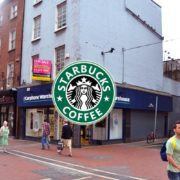
Bannon have recently let two units to Starbucks, the American coffee chain, namely at no. 8 North Earl Street, Dublin 1 and the Marshes Shopping Centre, Dundalk which was acquired by Kenny Wilson earlier this month.
Starbucks have taken the ground and basement of 8 North Earl Street under a sub-lease with 7 years unexpired lease term from Carphone Warehouse. The unit measures 129.5 sq.m with a ground floor retail area of 72.5 sq.m, Starbucks are believed to be paying a rent of €70,000 per annum with a minimal limited rent free period provided.
Starbucks have also agreed to take a unit at Marshes Shopping Centre, Dundalk which is understood to be a 20 year lease for 1,800 sq.ft at a rent of €60,000 p.a.
Daniel McLaughlin of Bannon who dealt with the lettings commented “there were a number of offers from established retailers for the property given the profile and high levels of passing footfall. We are witnessing demand for well-located city centre properties which far outstrips the availability currently within the market. We see this trend continuing for the foreseeable future as consumer spends recovers coupled with a lack of new stock being redeveloped.”
Irish Bank Resolution Corporation (IBRC) has appointed Liam Dowdall and Sean McNamara of Smith & Williamson accountants to take control of HCJV, the property arm of the Caulfield McCarthy retail group, one of the country’s biggest SuperValu franchisees which owns stores and shopping centres in eight locations around the country on foot of unpaid loans totalling more than €80m.
The Caulfield McCarthy group includes outlets at the Hypercentre in Waterford, Loughboy in Kilkenny, Bandon in Cork, Tipperary town, Merchant’s Quay in Cork city, Malahide in Dublin, and Enniscorthy and New Ross in Wexford. The retail side of the business Caulfield McCarthy Group Retail, is not in receivership, and the stores, which employ about 1,000 staff, will continue to trade as normal.
The loans were due to be sold on by IBRC as part of its liquidation, but according to the receivership appointment notices, it was the bank that put in Smith & Williamson, and not any third party loan buyer.

Bannon are delighted to bring to the market the sale of Rosemount Shopping Centre, Rathfarnham, Dublin 14. The shopping centre comprises a two level scheme with 8 retail units situated at ground floor and a further 4 commercial and offices units at first floor. The first floor units are served by two stairwells with a minimum quantum of common area to be maintained. There is an attractive Initial yield excess of 8%.
The scheme extends to 2,215.4 sq.m (23,846 sq.ft) with the benefit of 112 surface car parking spaces. This car park has been taken in charge by South Dublin Co. Council. Key tenants include Supervalu, Shannon’s Pharmacy, Rosemount Meats, Ray’s Catch, Fresh Fruit & Veg Delicatessen and Truly Scrumptious Café amongst other complimentary uses. The shopping centre has full occupancy with excellent income history.
For further details please contact Daniel McLaughlin, Rod Nowlan or Ben Semple of Bannon on 01 6477900

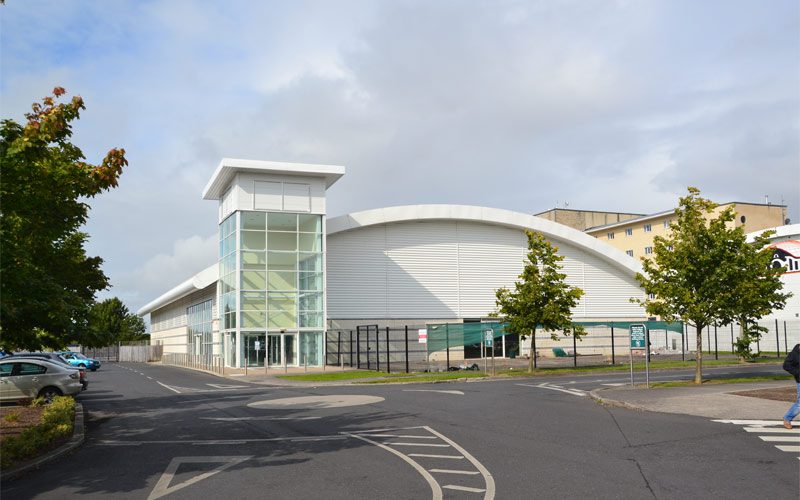
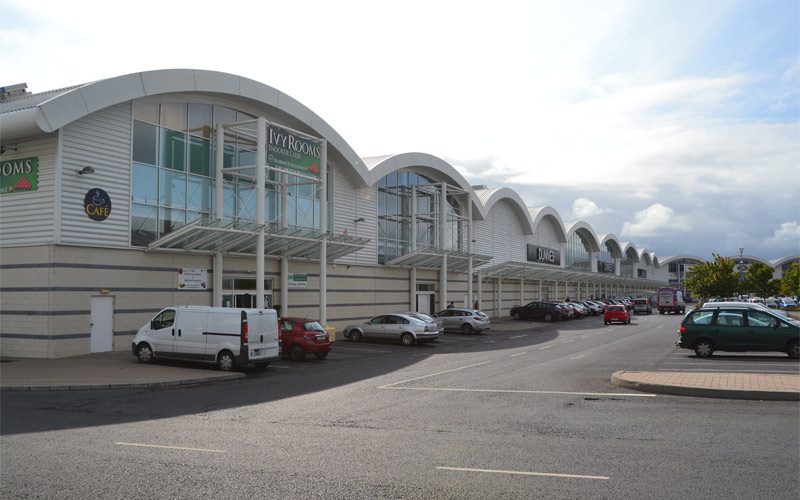
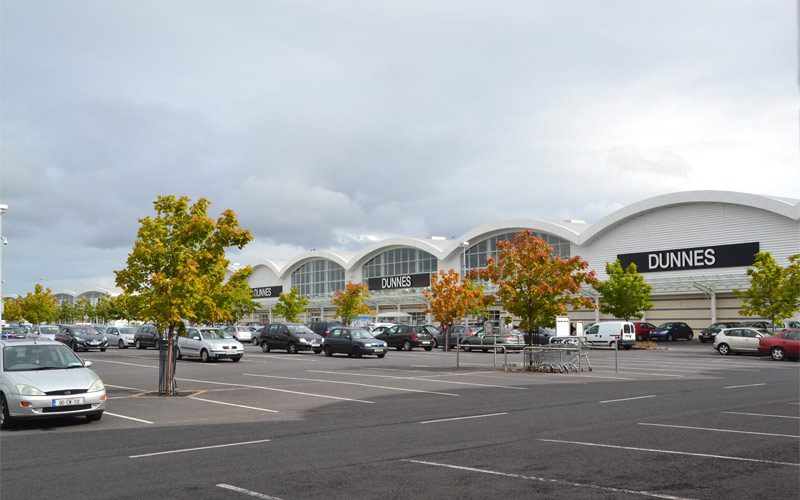
Barrow Valley Retail Park have 9 retail warehouse units for sale on the instructions of the Joint Receivers Michael Madden and Michael Coyle.
Units are available individually or as a single lot.
The units for sale extend to approximately 56,165 sq.ft on ground with mezzanine accommodation of approximately 18,435 sq.ft which forms part of a modern retail park scheme of 20,000 sq.m anchored by the only Dunnes Stores in Carlow. High profile location with over 500 metres frontage to the N80 Northern Relief Road and over 500 car parking spaces. Easily accessible, convenient location 2km from Carlow Town Centre.
Retail occupiers include Lifestyle Sports, Hughie Doyle Furniture, Tenants t/a The Ivy Rooms and Tyndall Clinic and Pharmacy. Leisure occupiers include The Talbot Hotel (80 bedrooms) and The Dome Leisure Centre. Motor occupiers include Ford Motors, Mitsubishi Motors and Meridian Motors.
For more information please contact Cian McMorrow on 01 6477900
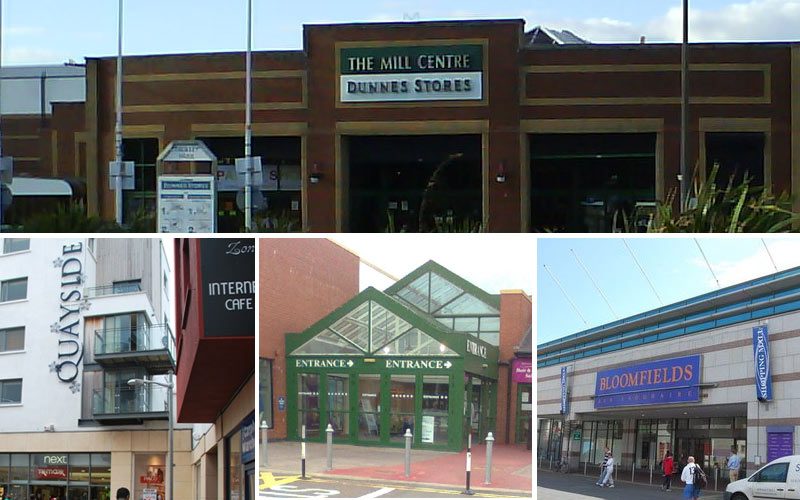
There are six Irish shopping centres to be offered for sale in a single lot by Lloyds Banking, named the Spectrum portfolio, in a further move to recover some of the development loans granted by Bank of Scotland Ireland.
Joint agents Bannon and Savills are quoting €120 million for the shopping centres at Douglas in Cork, Quayside in Sligo town, Bloomfields in Dún Laoghaire, Co Dublin, The Mill in Clondalkin, Dublin 22, Kilbarrack in Dublin 5 and Dundalk Retail Park in Co Louth. The sale also includes a rented three-storey office building in Clondalkin and 30 acres of development land adjoining Dundalk Retail Park.
The Spectrum portfolio’s seven assets produce approximately €11 million of income, which at a sale price of €120 million would offering a net initial yield in the region of 9%.
The retail schemes include:
First round bids are called for 10th October, with second and binding bids expected three weeks later before closure with the winning bidder slated for mid-November.
For further information please contact Rod Nowlan of Bannon on 01 6477900
The Spectrum portfolio, renamed from the portfolio’s original name of Project Thomond after peripheral Limerick assets were removed.
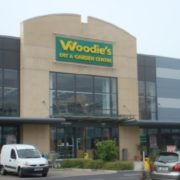
Woodies owner Grafton Group has reported a strong performance in their first half of the year, with revenue, profit and earnings per share all rising on the back of improving trading conditions. Profit before tax was up more than 280% from 24.5 million in the first six months of 2012 to 68.4 million in the same period this year, the company said in a statement.
The company said the merchanting business in Ireland reported a significant increase in revenue, which rose 5.6% from €114 million in 2013 to €121 million in the first six months of this year. Operating profit advanced “very strongly” from €1.5 million to €6 million and the operating margin increased by 3.3 percentage points to 4.%. The UK merchanting business, which constituted 73% of group revenue, performed strongly due to volume growth in the residential repair, maintenance and improvement market.
“The benefit of restructuring of its Woodies chain completed in the second half of 2012 that involved the consolidation of two stores and the realignment of rents to current open market levels in ten stores enabled the comparative half year loss to be eliminated and the business returned to profitability”, said Grafton.





| Title | Price | Status | Type | Area | Purpose | Bedrooms | Bathrooms |
|---|